MicroSaaS social listening with Claude versus manual group scrolling and why the assisted workflow wins
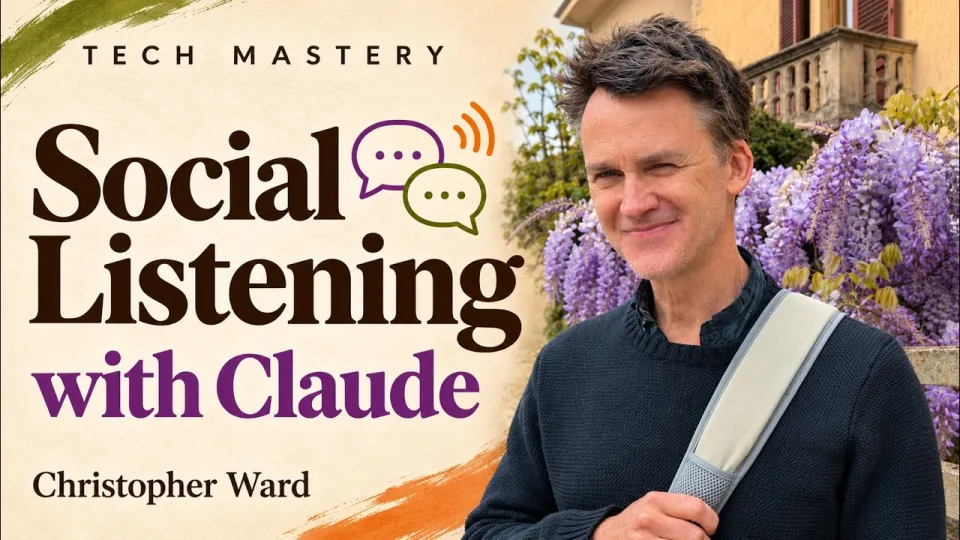
Video: MicroSaaS: Master Social Listening with Claude
· based on the channel DreamTechBFF
MicroSaaS social listening with Claude beats manual group scrolling because it turns a daily 30–50 group sweep into a scheduled task that finds people asking for help, drafts a reply and queues it for your approval. You keep the judgment, Claude does the reading, and the pitch only happens after you have been useful. The punch list skills shown in the DreamTechBFF breakdown live in the Premium tier of Tech Mastery for Entrepreneurs, so you can copy the workflow instead of rebuilding it from scratch.
Why MicroSaaS founders pick Claude over manual scrolling
The core argument for the assisted workflow is arithmetic: a founder can read maybe two or three Facebook groups carefully in a day, while a scheduled task can cover 30–50 without fatigue. The example used in the video is Patente Decoded, an app that helps expats pass the Italian driving test. Its target audience does not hang out on a product website; it congregates in expat Facebook groups where people post questions like "has anyone done the patente exam in Italian?" or "which quiz app actually matches the official test?". Those posts are buying signals, and they appear and disappear within hours.
Manual scrolling fails on three counts. First, coverage: you miss most groups because you simply cannot read them all. Second, timing: by the time you notice a thread, twenty other people have answered. Third, consistency: on a busy product day, listening is the first habit to be dropped. A Claude-driven punch list fixes all three because it runs on a schedule, produces a shortlist, and leaves the human in charge of the final wording.
The result reported in the video is that roughly 80% of the app's sales come from this workflow. That number is worth pausing on: it means social listening is not a side channel for this MicroSaaS, it is the acquisition engine.
How the daily punch list scheduled task works
The punch list is a scheduled task, not a chat you remember to open. Each morning it runs a scan and returns a report with today's shortlist of threads worth entering. Build it in four steps:
- Define the niche and the exact question patterns. For Patente Decoded that means phrases about the Italian driving test, the theory exam, official quiz formats and expat licence conversion.
- List the sources. In this case, 30–50 Facebook expat groups, chosen because that is where the audience already asks for help.
- Set the output format. A report with the group name, the question asked, a one-line read on intent and a drafted reply.
- Schedule it daily and keep the review step mandatory.
The report is the product. Instead of an endless feed, you get a shortlist you can clear in fifteen minutes, which is the difference between a listening habit that survives a busy week and one that collapses by Thursday.
Which connector to use for each platform
Connector choice decides whether the workflow is reliable or fragile. For Facebook groups, the video uses Claude in Chrome: the browser agent opens each group, reads the visible posts and extracts the relevant questions. That approach works because Facebook groups are a logged-in, visually rendered environment with no clean public API for this kind of reading.
For Reddit, the recommendation is Composio rather than the browser route, because Reddit content is structured and accessible through an integration, which is faster and less brittle than screen reading. As a rule of thumb: use a structured connector where one exists, and fall back to the browser agent where the platform only exists behind a login.
A practical caution for anyone building a MicroSaaS listening stack: browser automation depends on page layout, so a platform redesign can break extraction overnight. Keep the prompt specific about what a qualifying post looks like, and check the first few runs by hand before trusting the report.
The rules that keep social listening from becoming spam
The operating principle is to be helpful first and never pushy. A drafted reply that opens with a product mention reads as an advert and gets ignored or removed; a reply that answers the actual question earns the right to a link. The video is explicit that you should participate before you pitch: join the conversation as a knowledgeable person, then let the product come up when it is genuinely the answer.
In practice this means the draft should contain the substance of the answer, the exam format, the common mistake, the realistic timeline, and only then, if relevant, a mention of the tool. Many shortlisted threads will not deserve a product mention at all, and that is fine; those replies build the reputation that makes later ones convert.
Reviewing and approving every reply before it posts
Claude can post the replies, but only after you approve them. The workflow deliberately keeps a human checkpoint: you read each draft, edit the tone, delete the ones that feel off, and approve the rest. The reason given in the video is simple, and it is the right one: you review every post yourself because a bad reply in a community group damages trust that took months to build, and because automated posting without oversight is exactly the behaviour that gets accounts banned and groups moderated against you.
Treat the approval step as the quality filter, not a formality. Read the draft as a group member would, ask whether it answers the question even without the product, and cut anything that sounds like a template. The drafting is Claude's job; the voice is yours.
Adapting the punch list to Skool and other niches
The system is not specific to driving tests. The same punch list structure can be pointed at Skool communities, using Skoolgrades for the Skool side, and at any niche where people ask questions in public: yoga, wellness, marketing, fitness, finance. The variables that change are the keyword patterns, the list of communities and the tone of the draft; the mechanics, scheduled scan, shortlist report, drafted replies, human approval, stay identical.
For a MicroSaaS founder, that portability is the real asset. Once the punch list is running for one niche, cloning it for a second audience costs a prompt edit and a new source list, not a new hire.
Where to get the punch list skills
The punch list skills from the video are available in the Premium tier of Tech Mastery for Entrepreneurs, and the same skills are offered directly from the sales page linked in the video description. If you would rather build your own version, start with one platform, one niche and ten groups, prove the report is useful for a week, then scale to 30–50 sources. The DreamTechBFF breakdown is the most concrete walkthrough available of this workflow applied to a real MicroSaaS, and it is worth watching end to end before you configure your first scheduled task.
Key takeaways
- A scheduled Claude task scans 30–50 Facebook expat groups every day for people asking about the Italian driving test.
- About 80% of the app's sales come from this single social listening workflow.
- Claude in Chrome reads each group; Composio is the connector of choice for Reddit.
- Every drafted reply is reviewed and approved by the founder before Claude posts it.
- The same punch list system can be rebuilt for Skool communities or any niche such as yoga, wellness or marketing.
Source: MicroSaaS: Master Social Listening with Claude · Markdown version
Questions & answers
What exactly is a punch list in this social listening workflow?
It is a scheduled Claude task that scans a fixed list of communities, in the example 30–50 Facebook expat groups, and returns a daily report with the relevant questions and a drafted reply for each. You clear the shortlist, approve or edit the drafts, and Claude posts the approved ones. The point is a bounded daily list instead of an endless feed.
Why use Claude in Chrome for Facebook groups but Composio for Reddit?
Facebook groups sit behind a login with no clean public API for this kind of reading, so a browser agent that opens each group and reads the visible posts is the practical route. Reddit content is structured and reachable through an integration, so Composio is faster and less brittle than screen reading. Use a structured connector where one exists and the browser where it does not.
Can Claude post replies automatically without my approval?
It can, but the workflow deliberately does not let it. Every draft is reviewed and approved by the founder first, because a careless reply in a community group damages trust and can get an account restricted. The approval step also keeps your voice in the replies rather than a generic template tone.
Does this workflow only work for an app about the Italian driving test?
No. The example is Patente Decoded, where roughly 80% of sales come from the workflow, but the same structure works for Skool communities via Skoolgrades and for niches such as yoga, wellness or marketing. Only the keyword patterns, the community list and the reply tone change; the scheduled scan, report and human approval stay the same.